



Teaching a Music Ensemble is Actually Teaching the Foundations of a Civilised Society.
I stand behind a music stand, my coffee-soaked brain cells bounding through a list of objectives for the morning’s rehearsal. Hurried pencil markings, highlighted sections and tattered page corners adorn the score of music that lies upon the stand, scribbled remnants of late-night preparation and a lifetime of musical opinions.
Five minutes later the first student enters. They’re the early arriver, quietly saying good morning and beginning to set up their peers’ chairs and stands. Are they selfishly wanting the rehearsal to start on time, or is this real charity, genuine humble helpfulness, an act for others that contributes to a better-functioning environment? More students arrive, some help, some leave the room they just arrived in, disassociating in protest at the early morning hour.
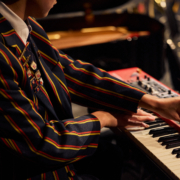
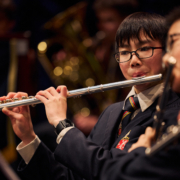
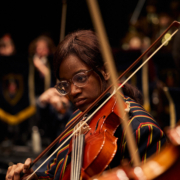
“I forgot my mouthpiece,” one young student pronounces. Zero sense of worry in their voice despite their instrument having been rendered useless. “Do you have a Flute 2 part? I’ve lost mine,” another voice sheepishly utters. A cymbal crashes; not hit, knocked over. An ugly sound that could only be coaxed from an orc in The Lord of the Rings emerges from a Baritone Saxophone being wielded by a trombone player who has just swapped instruments for a laugh. In this moment the details on my score become meaningless.
It dawns on me. I’m not teaching music. I’m teaching Civilisation 101. Making this ensemble of vastly different personalities work together is teaching the very foundational skills that define a civilised society. Under the premise of retrieving the lost music and mouthpiece, I run to my office and confirm my hunch by making a quick Google search on the foundational elements of a civilisation. I run back to the rehearsal with everything I need.
“Bar 64 – Oboe Solo,” I utter to the group. Thirty-four individuals, some with nothing but rests in their parts, have to quietly listen, awaiting their musical response to the oboe’s long phrase. In this moment, students practice sitting quietly in a room, listening whilst someone is talking (in this case playing), before joining in unity or an accompanying harmony. Is this music I’m talking about, or a Nirvana-esque society on a Thai beach in a Leonardo DiCaprio film? Either way, it’s working: the students are focused, inspired by the persuasive, direct sound of the oboe.
The piece rolls on. I look around the room: a complex division of labour, [1] another hallmark of civilisation. The low brass have minimal notes, their role rooting the harmony with timbral fullness, while the violins frantically tear through scalic passages. I work on the balance of sound, each individual’s volume and blend, the students beginning to appreciate and understand their role in our microcosm of Ancient Rome.
I count the group in, my voice giving way to the moving beat of the baton. Its gestural pulse begins appearing in the movements of each player. We are sharing a common language of communication, agreeing on a tempo, a common law or boundary within which we are free to express ourselves in our individual roles. In real time, the students exercise emotional responses to the movements, practising individual and creative freedom in shaping their own part whilst still understanding the context of their role in its current environment.
The clock on the wall hits 8:30 a.m., the final agreed-upon constraint on our behaviour. I look around at the different instrument groups — the winds, the brass, percussion and strings — forming their distinctly different territories. Families of completely different individuals are geographically divided in the room by type but united in a greater purpose with their neighbours.
I look down at the words I’d printed out from my office: Robert D. Putnam’s definition of social capital: “the networks, norms of reciprocity, and trust that arise from associational life and that enable coordinated, cooperative action for mutual benefit.” [2] He might have been referring to political science, but I just taught my orchestra how to exist together as good humans, and what’s more… they had fun in the process.
“Thanks for the rehearsal Dr Vaudrey.”
I smile and head out in search of another coffee.
Dr Richard Vaudrey
Head of Studio and Instrumental Music
Author: Dr Richard Vaudrey is Head of Studio and Instrumental Music at Peninsula Grammar and the driving force behind the School’s newly designed Peninsula Grammar Music Academy. A respected cellist, educational writer and presenter for the Melbourne Symphony Orchestra, he also serves as conductor of the Victorian State School Spectacular Orchestra for the Victorian Department of Education.
[1] “Key Components of Civilization.” National Geographic Education, National Geographic Society, 30 May 2025, education.nationalgeographic.org/resource/key-components-civilization/
[2] Putnam, R. D. (1995). “Bowling Alone: America’s Declining Social Capital.” Journal of Democracy. https://www.journalofdemocracy.org/articles/bowling-alone-americas-declining-social-capital/


Related news
Building a Global Learning Community